Risk-⁠based grid decisions under uncertain forecasts

Operational security at the lowest system cost

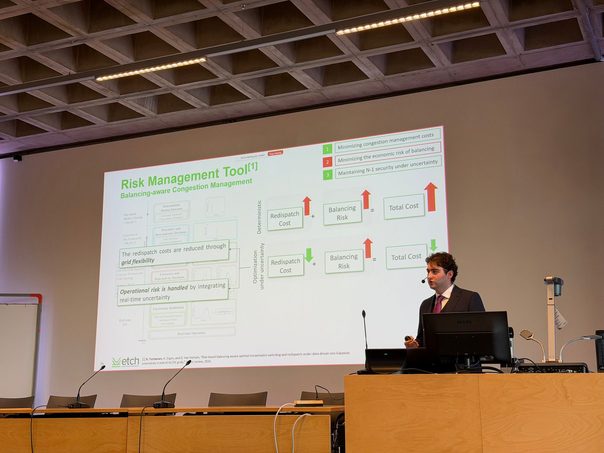
An illustration of a generic power system as a model on a plinth, not a real place. Wind turbines stand at sea and on low hills, next to a field of solar panels, a battery park, a gas-fired power plant with two chimneys, a factory and a town. Overhead lines on towers join nine substations, and two HVDC links end in converter stations. The offshore link carries what the wind farm produces, and the other, an interconnector, keeps the exchange agreed for each hour. Above the wind farms at sea and on the hills and above the solar field, points of light show how much each could produce tomorrow, hour by hour, as a band between no output at the bottom and full output at the top; 8 in 10 outcomes fall in the more strongly drawn middle. Every ten seconds or so one band folds onto a single hour, and its points stack into the spread of outcomes for that hour, which turns to stand as a distribution, with no output on the left and full output on the right; sometimes it rises into a diagonal band that shows how the outcome follows the forecast; then it folds back. Where points press against no output or full output, that edge glows. A fourth field behind one line of the grid shows how loaded that line could be against its limit, an upright rail. On a windy day some points pass the rail and turn warm, and when another line is switched out they move back below it. Two stories run in the model. In the first, which repeats every 48 seconds, the market schedule for the next evening overloads one line in the middle of the grid. A decision taken the day before relieves it. Another line is switched out at both ends, the power takes the parallel lines and the overloaded line cools below its limit, and the battery park and the gas-fired plant shift output against each other. The next evening the line stays cool while the wind varies, and it is switched back in for the next, calmer hour. The second appears when the research theme on balancing-aware congestion management is highlighted, and a biomass power station with a cooling tower stands in front of the overloaded line. On the same congested evening the operator switches another line out and moves three units in one decision, the battery park and the biomass power station up and the gas-fired plant down by as much, and the line cools below its limit. A small chart shows the zone's balancing offers as steps, cheapest first, and each unit's move adds or removes its own offers. The next day the wind falls short; the battery park's cheap offers cover it, and the whole shortfall is paid the price of the last offer used. Dashed, the cheapest redispatch would have used up most of those offers, so the same shortfall would reach the gas-fired plant's offers and settle at a higher price; two columns show that it pays less to move the units and more in total. When the research theme on HVDC is highlighted, the rest of the model fades back and only the two HVDC links stay lit, with their converter stations, in a color of their own; light runs along each cable in the direction power flows. The model then plays one day of market hours in about half a minute and repeats it while the theme stays highlighted. The offshore link always carries the wind farm's output ashore; its light runs faster and the link grows wider as the wind rises, and slower and thinner as it falls. The interconnector to the neighboring grid keeps the exchange the market agreed for each hour; at four of the hour changes its light slows, goes out and runs back the other way, between export and import. Light runs along the lines and cables in the direction power flows, brighter on more loaded lines; a line that is switched out goes dark and the light takes the other paths. Except while the research theme on HVDC is highlighted, the light on the two HVDC links is even along the cable instead of running in streaks, because each link carries one direct current, held by the converters at its ends, so its light changes only when their set-point changes and stays the same when a line of the grid is switched.

Research focus

Latest

All news

Selected publications

All publications